
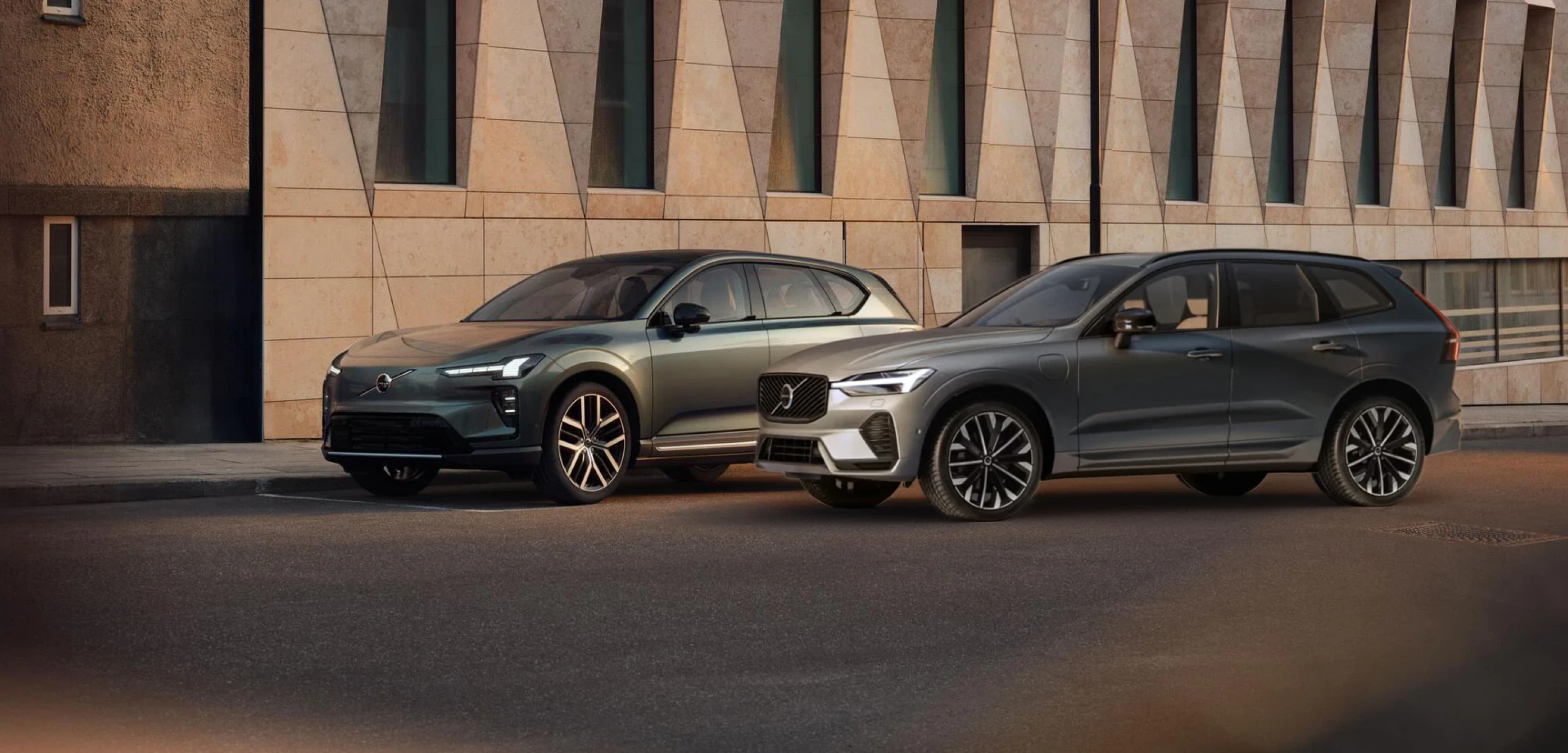
Volvo EX60 vs Volvo XC60: Which Should You Choose?
If you can charge at home, the EX60, and it costs slightly less to buy than the XC60, not more. The EX60 starts at €66,695 against €67,145 for the XC60 plug-in hybrid and offers 620 to 810 km of range. The XC60 is the answer if charging is unreliable for you.
Most people assume the electric car is the expensive one. In this pairing it is not, which makes the decision cleaner than usual.
The Biggest Difference
The XC60 in Ireland is now a plug-in hybrid. A 2.0 litre turbocharged petrol engine pairs with an electric motor and an 18.8 kWh battery, giving up to 79 km of electric range before the petrol engine takes over. The T6 AWD produces 335 hp, the T8 AWD 406 hp.
The EX60 is fully electric, the electric equivalent of the XC60, and Volvo’s first car on its new SPA3 platform. It is also the first Volvo to use an 800-volt electrical architecture, with battery cells built directly into the body structure.
What They Cost
Model | Powertrain | Road tax | From |
Volvo EX60 | Fully electric | €120 | €66,695 |
Volvo XC60 | Plug-in hybrid T6 / T8 AWD | €140 | €67,145 |
The €450 gap is small enough to be irrelevant to the decision, but the direction matters. There is no price penalty for going electric here, which removes the usual first objection.
Prices are starting figures and exclude delivery, paint and options. Contact us for on-the-road pricing on your chosen specification.
Does the Volvo EX60 Qualify for the SEAI Grant?
Neither car qualifies for the SEAI purchase grant. Since 31 July 2026 the grant applies only to new electric cars priced between €14,000 and €50,000, and both of these sit well above that ceiling.
That is worth knowing before you budget. If grant support is central to your decision, the EX30 is the model in our range that still qualifies, ask us about it.
Range and Charging
This is where the EX60 stands out the most. Three versions are offered:
• P6 rear-wheel drive: 80 kWh usable, 374 hp, 620 km WLTP, 0–100 km/h in 5.9 seconds
• P10 all-wheel drive: 91 kWh usable, 660 km WLTP
• P12 all-wheel drive: 112 kWh usable, up to 810 km WLTP combined and up to 980 km in urban driving
Even the entry P6 covers a Waterford to Dublin round trip on a single charge in mild conditions. The P12 is among the longest-range electric cars on sale anywhere.
The charging is arguably the bigger story. The 800-volt architecture supports up to 320 kW on the P6 and 370 kW on the AWD versions, 10% to 80% in around 18 minutes, or roughly 340 km of range added in ten minutes. It is the fastest-charging Volvo built to date, and it changes what a long journey looks like: a coffee stop rather than a planned break.
At home, an 11 kW onboard charger is standard with 22 kW available.
The XC60’s Case
The plug-in hybrid answers one question the EX60 cannot: what if you cannot charge reliably?
With 79 km of electric range, an XC60 charged overnight covers the majority of commutes on battery alone. When it does not, the petrol engine takes over with no planning required. For anyone doing long, unpredictable journeys at short notice, or anyone without off-street parking, that flexibility is worth real money.
It is also the more powerful car in T8 form at 406 hp, and it is a known quantity: a car Volvo has been refining for years rather than a new platform in its first year.
The honest caveat on plug-in hybrids: the economy figures only hold if you actually plug it in. Run an XC60 with a flat battery and you are carrying the weight of a battery pack around with a petrol engine doing all the work. If you would not charge it regularly, the case for it weakens considerably.
Towing
Better than most people expect from an electric SUV. The EX60 P6 is rated at 2,000 kg braked, rising to 2,400 kg on the P10 and P12 all-wheel-drive versions.
That covers a laden two-horse trailer, a decent caravan or a plant trailer. If you tow, tell us the weight and we will confirm the rating for your chosen version and for the XC60 before you order.
Running Costs
The EX60 is the clear winner here.
Charged at home on a night-rate tariff of roughly 6-12c/kWh, the EX60 costs a few hundred euro a year at typical mileage. The XC60 will use petrol on any journey beyond its 79 km electric range, and at Irish pump prices that adds up quickly over a year of mixed driving.
Servicing also favours the EX60: no oil, no filters, no spark plugs, and regenerative braking means pads and discs last considerably longer.
The Deciding Question
It comes down to one thing, and it is worth answering honestly.
Can you charge at home overnight? If yes, the EX60 is the better car and the cheaper one, both to buy and to run. The range removes the usual objections and the charging speed removes most of the rest.
If you cannot charge reliably — no driveway, or you regularly drive long distances at no notice — the XC60 is the sensible choice. Public charging in Ireland costs several times the home night rate, and relying on it erodes the electric advantage.
The Verdict
The EX60 is the more advanced car, the cheaper car and the cheaper one to run. For most buyers with off-street parking, it is the straightforward answer, and the fact that it undercuts the XC60 on price makes it an unusually easy recommendation.
The XC60 remains the right car for a specific and sizeable group: drivers without home charging, and those whose journeys are long and unplanned.
Both are available at Auto Boland Volvo Cars on the Cork Road in Waterford. The EX60 is a new arrival, so call ahead on 051 337900 and we will let you know what is available to see and when we can get you behind the wheel.
Frequently Asked Questions
Is the Volvo EX60 cheaper than the Volvo XC60 in Ireland?
Yes, marginally. The EX60 starts at €66,695 against €67,145 for the XC60 plug-in hybrid. The fully electric model is the cheaper of the two to buy and to tax.
What is the range of the Volvo EX60?
Between 620 km and 810 km WLTP depending on version. The P6 rear-wheel-drive returns 620 km, the P10 AWD 660 km, and the P12 AWD up to 810 km combined.
How fast does the Volvo EX60 charge?
The EX60 uses an 800-volt architecture supporting up to 320 kW on the P6 and 370 kW on the AWD versions, taking 10% to 80% in around 18 minutes. It is the fastest-charging Volvo to date.
Can the Volvo EX60 tow?
Yes. The rear-wheel-drive P6 is rated at 2,000 kg braked and the all-wheel-drive P10 and P12 versions at 2,400 kg, which is strong for an electric SUV.
Does the Volvo EX60 qualify for the SEAI grant?
No. Since 31 July 2026 the SEAI grant applies only to new electric cars priced between €14,000 and €50,000, and the EX60 sits above that ceiling.